Bissinger did not write a civil-rights history — but the one embedded in his reporting has outlasted much of what Odessa preferred to remember.
What Bissinger Put on the Record
When H. G. Bissinger arrived in Odessa in 1988 to follow the Permian Panthers through their season, he found a football program celebrated as a civic religion and a school district whose integration history had been neither fully reckoned with nor forgotten. The passages he wrote on race in Friday Night Lights — published in 1990 — were among the most contested in the book and among the most documented. Ector County Independent School District had operated a formally segregated system for decades after World War II, with Black students assigned to Blackshear Elementary and, at the secondary level, to Ector High School rather than the white-designated Permian or Odessa High. The timeline of desegregation in Ector County ran well behind the 1954 Brown v. Board of Education ruling, as it did across most of West Texas, where federal enforcement pressure, not local initiative, drove the eventual consolidation of schools.
Bissinger documented the texture of what that history had deposited in the program by 1988: the gap between the resources devoted to Permian football and those available to students — disproportionately Black and Hispanic — who were not part of the athletic apparatus the district prized. He noted the disparity in special-education spending and academic support relative to the football budget, a contrast that landed in Odessa like an accusation because it was stated in numbers rather than impressions. The Ector County ISD's expenditure on athletic facilities in that era, set against what the district allocated per pupil for remedial and special-education services, became one of the book's most-cited passages in subsequent discussions of Texas school finance.
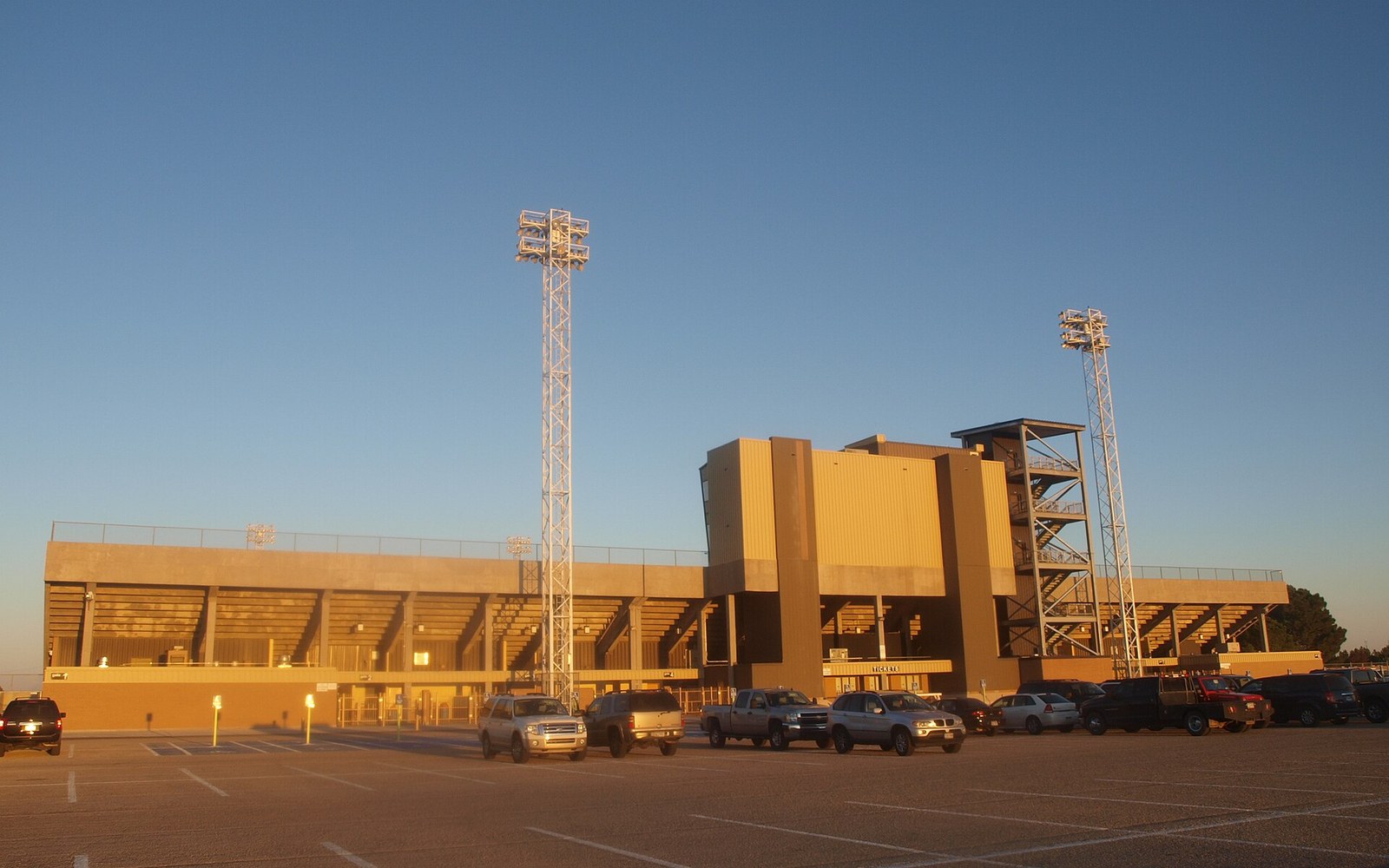

Ratliff Stadium seats 19,302 — roughly a fifth of the city Odessa was at the 1980 census. The district's income has followed the Permian Basin since before the stadium was built.
Photo: Ratliff stadium · Wikimedia Commons · Photo: jayjay13 / PexelsThe Integration Timeline
Texas's University Interscholastic League did not formally permit Black schools to join its structure until 1967, when it absorbed the Prairie View Interscholastic League, the separate governing body that had administered Black athletics across the state. That absorption date is the clearest institutional marker of when Black student-athletes in Ector County could compete within the same UIL bracket as Permian — and it preceded Permian's 1972 state title, meaning the program's dynastic run was built, from early in its history, on a nominally integrated but still stratified system.
In practice, the social and academic integration of Ector County schools moved unevenly through the late 1960s and into the 1970s. Federal desegregation orders applied to Texas districts through the courts during this period, and the Ector County ISD's compliance history followed the pattern common across the region: formal unification of attendance zones accompanied by informal pressures — residential segregation enforced by the oil-patch economy's housing patterns, coaching hierarchies that took years to reflect the new demographics, and a booster culture organized around Permian that had not been built with Black families at its center.
What the Book Made Visible That Local Coverage Had Not
What gave Bissinger's treatment of race its staying power was not that the facts were unknown in Odessa — they were known, selectively, by people old enough to have lived them — but that they were placed inside a work of national literary nonfiction that received a National Book Critics Circle nomination and was reviewed in outlets that Odessa's civic leadership could not ignore. The Dallas Morning News, Sports Illustrated, and Texas Monthly all engaged with the book's racial argument in their coverage. The town's documented reaction — anger at Bissinger, protests of his portrayal, public statements by boosters and officials — concentrated heavily on the book's portrait of academic neglect and racial inequity rather than on the football reportage, which local readers might otherwise have relished.
James "Boobie" Miles, the running back whose catastrophic knee injury in the 1988 preseason runs through the book as an emblem of what the program extracted from its players, was one of those players: a young Black man for whom football was the school's primary investment and whose future the program could not protect once that investment became worthless. Bissinger did not editorialize heavily; he reported the structural condition and let the symmetry speak. That restraint is part of why the racial record he assembled in Friday Night Lights remains the most cited account of what Ector County's schools looked like at the end of their first full generation of nominal integration.