
Head-Coaching Pay as a Structural Statement
When Texas Monthly and the Dallas Morning News have periodically surveyed head-coaching compensation at the state's largest school districts, the numbers carry an argument of their own: Texas high-school football is not treated as an extracurricular. It is treated as an institutional priority, and the payroll reflects that.
At the upper end of the 6A tier — the University Interscholastic League's largest enrollment classification — head coaches at programs such as Allen, Katy, and Lake Travis have drawn total compensation packages reported in the low-to-mid six figures, a range that in some cases exceeds what assistant professors at Texas public universities earn in the same budget year. The Dallas Morning News has documented these figures through public-records requests to individual school districts, since Texas school employees are public employees and their salaries are subject to disclosure under state open-records law.

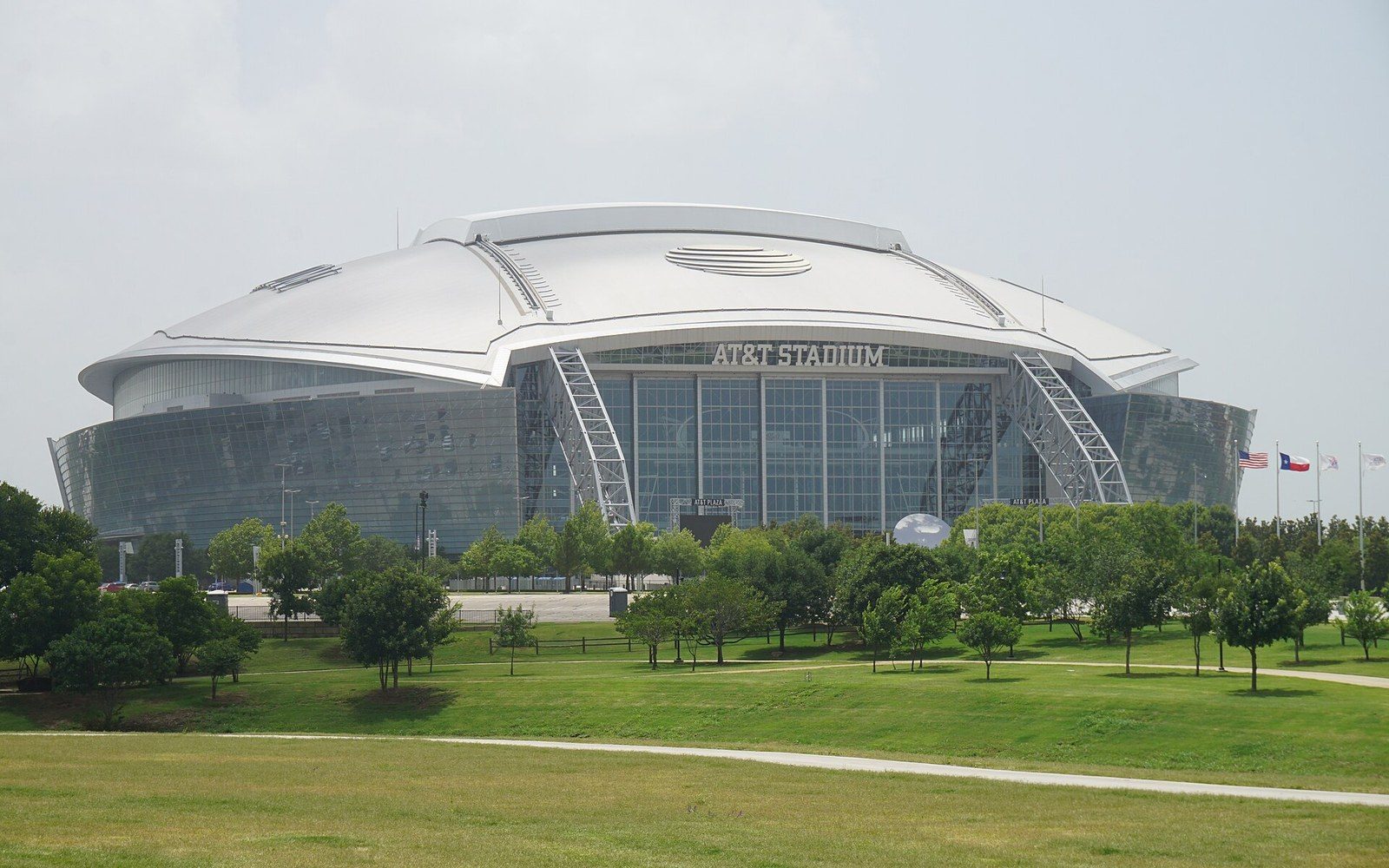
Friday lighting is district infrastructure in West Texas, maintained out of a school budget. Texas high-school football is broadcast property, bought and sold as such.
Photo: Radik 2707 / Pexels · Photo: Arlington June 2020 4 (AT&T Stadium) · Wikimedia CommonsThe structural point is not simply that the numbers are large. It is what surrounds them. A 6A head coach at a program with playoff expectations typically commands a dedicated weight-room staff, a full-time offensive and defensive coordinator, and a facilities budget underwritten partly by booster culture — the organized financial network that supplements district spending with private contributions for equipment, travel, and facility improvements. The base salary is the floor, not the ceiling.
Texas Monthly framed the phenomenon in similar terms when examining the 6A stadium arms race that produced facilities such as Allen ISD's sixty-million-dollar stadium in 2012 and McKinney ISD's seventy-million-dollar ground in 2018. Coaching compensation and capital construction belong to the same logic: a community that will approve a bond for a purpose-built football stadium will also approve a contract that pays its head coach accordingly.
What H. G. Bissinger documented in Friday Night Lights — that Odessa's commitment to the Permian Panthers was economic and civic before it was athletic — finds its present-day expression in those salary lines. The oil-patch economy that funded Ratliff Stadium and its nineteen-thousand-seat capacity in 1982 has its structural descendants in wealthier suburban districts where property-tax bases, not petroleum, generate the revenue. The mechanism differs; the seriousness of purpose does not.
No figure in this record is ceremonial. A school district does not offer a six-figure public contract to signal enthusiasm. It does so because it has decided, through whatever political process governs such decisions locally, that winning football is worth that price.