The Numbers Universal Took to the Bank
Friday Night Lights opened on 8 October 2004 on roughly 2,500 screens across North America. Its opening weekend, as reported by Box Office Mojo, came in at roughly $20 million, second only to Shark Tale — a strong debut for a drama built around a regional sport and a relatively unknown cast. The film's domestic theatrical gross ultimately settled at just over $61 million, making it a modest but genuine success by the standards Universal Pictures and Imagine Entertainment had set for a non-franchise drama with no marquee action elements.
The production budget, as widely reported at the time of release, was in the range of $30 million — a figure that placed Friday Night Lights in the mid-tier of studio drama production rather than the prestige-blockbuster bracket. Against that number, a $61 million domestic return represented a workable theatrical multiple before home-video revenue, international receipts, and ancillary sales were counted. Universal had not greenlit the project expecting a Remember the Titans-style crossover hit; the expectation was that a serious adaptation of H. G. Bissinger's 1990 book — one that carried a National Book Critics Circle nomination and had sold steadily for over a decade — would find an adult audience willing to pay for something that felt more documentary than spectacle.

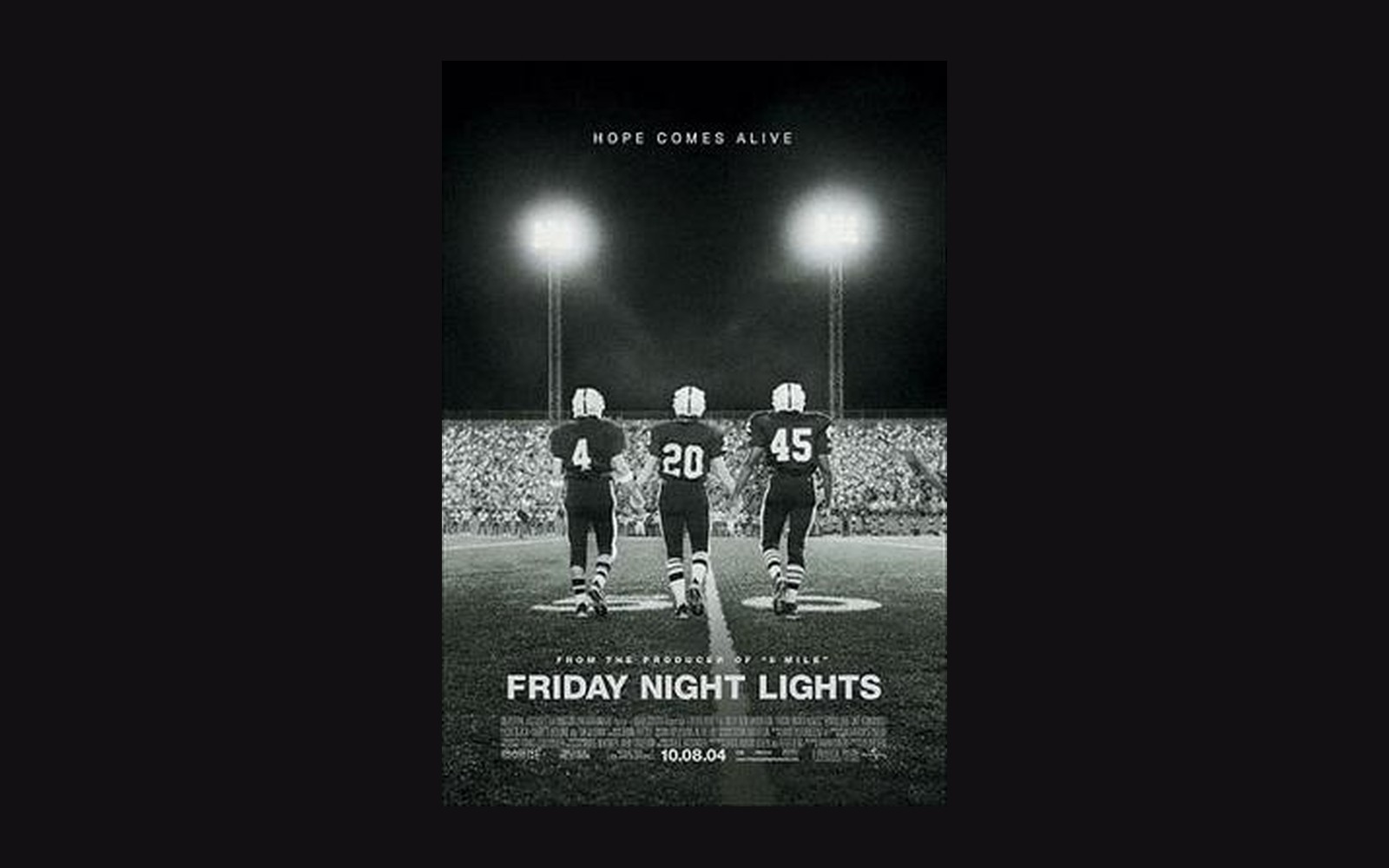
Thornton took the part of a coach written around restraint. Universal's one-sheet carried the release date and the numbers on three jerseys; the town is not named on it.
Photo: Billy Bob Thornton 2008 (2) · Wikimedia Commons · Photo: Friday Night Lights (film) · Wikimedia CommonsPeter Berg's directorial choices reinforced that positioning. Tobias Schliessler's cinematography, with its handheld passages and flat West Texas light, read on screen as authentically unglamorous, which is precisely what drew critics but slightly narrowed the audience. Billy Bob Thornton's performance as Gary Gaines was praised almost universally, and Tim McGraw's casting against type generated genuine press attention. Neither translated into the broad family-audience draw that football-movie precedents suggested was available.
What the gross confirmed, when read carefully, is that the film performed within the band Universal had planned for. The opening-weekend-to-total-domestic ratio — roughly 1-to-3 — indicates steady, word-of-mouth-sustained legs rather than a front-loaded opening that collapses by the second weekend. Audiences who came to Friday Night Lights in weeks two and three were largely adults who had read Bissinger's book, seen the reviews, or had a personal connection to Texas high-school football; they were not, in significant numbers, the teenage sports-movie crowd.
The domestic theatrical result as tracked by Box Office Mojo sits, in retrospect, as the financial foundation on which Universal and Imagine could justify the television adaptation that followed. A film that had lost money would not have warranted the conversation; $61 million domestic, with strong ancillary performance, made the NBC series a defensible pitch. The box office did not make Friday Night Lights a cultural phenomenon — but it kept the door open for the project that eventually did.