
The Stillness at the Center
H. G. Bissinger's Gary Gaines is not a shouter. In Friday Night Lights the book, the Permian Panthers' head coach absorbs the pressure of an entire West Texas city with a kind of watchful compression — absorbing booster anger, managing teenage egos, and processing the particular loneliness of a man whose professional survival depends on seventeen-year-olds staying healthy. He is not an orator. He is a manager of anxiety, including his own. That quality made him nearly impossible to cast.
Peter Berg and Brian Grazer's Imagine Entertainment needed an actor who could anchor every tense scene without converting tension into performance. The obvious casting trap — the inspirational-speech coach, the Knute Rockne archetype — would have turned the film into the movie that Friday Night Lights was explicitly trying not to be. Berg has spoken in production interviews about needing someone whose face could carry what was unspoken; Billy Bob Thornton was that actor.
What Thornton Brought to It
Thornton's public persona in 2004 was eccentric, voluble, outwardly odd. His performance as Gary Gaines ran entirely against that grain. He plays the coach as a man who has learned to convert every public emotion into a controlled signal — a flicker of the jaw, a glance held a half-second too long, a voice that almost never rises above conversational. In the locker room scenes, where another actor would have reached for crescendo, Thornton keeps the register low. The team leans in. So does the audience.

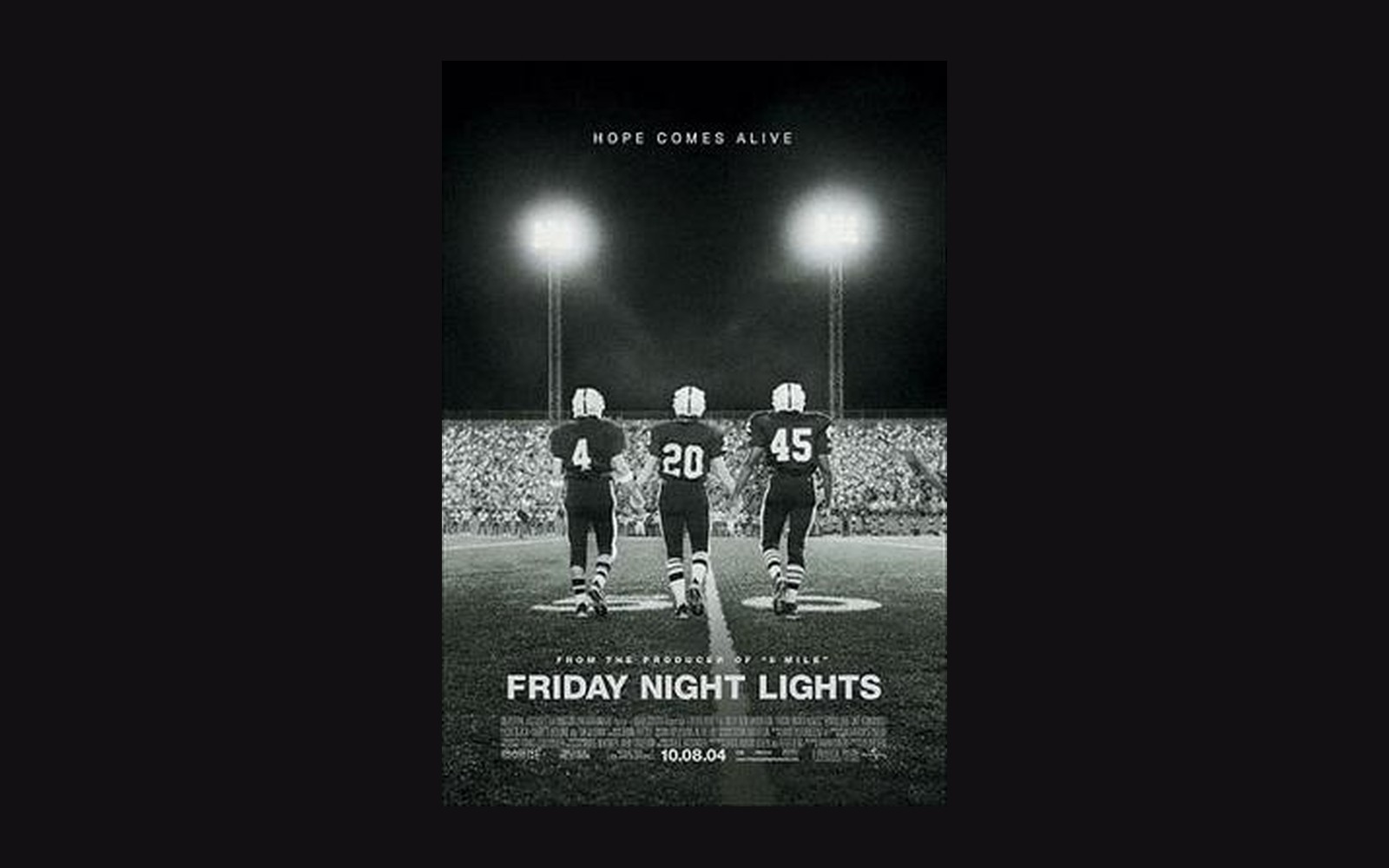
Thornton took the part of a coach written around restraint. Universal's one-sheet carried the release date and the numbers on three jerseys; the town is not named on it.
Photo: Billy Bob Thornton 2008 (2) · Wikimedia Commons · Photo: Friday Night Lights (film) · Wikimedia CommonsThe approach is visible most clearly in the halftime sequences, where the camera — shot handheld and in close quarters by cinematographer Tobias Schliessler — gives Thornton no room to perform broadly. He fills the frame by doing almost nothing. His Gaines pauses before speaking; lets the silence cost something. It is a technique that depends absolutely on the audience already understanding what is at stake, which is why the film's first act — the booster pressure, the community expectations, the fragility of Boobie Miles's knee — must land before any speech from Gaines can mean anything.
Thornton has noted in interviews that he approached the role as a man carrying a private conversation at all times, one he cannot share with players, parents, or the boosters who openly question his job security in grocery stores. That interiority is the character's engine. Where Bissinger's book rendered Gaines's inner life through reported observation across a full season, Thornton had to compress it into expression: the set of the shoulders, the way he sits at the far end of a bench and watches practice as though calculating something no one else can see.
The performance is also a study in occupational identity. Gaines, in Thornton's reading, is a man who cannot separate himself from the job — not out of obsession, but because the job has become the only language he knows fluently. The scene in which his wife (played by Connie Britton in a brief film role that anticipated the fuller Tami Taylor of the series) pushes back against the community's hold on him is the one moment the interior conversation surfaces, and even there Thornton underplays it, making the vulnerability feel cornered rather than confessed.
The Real Gaines, After the Film
The contrast between Thornton's performance and the real Gary Gaines's subsequent career adds a layer the film cannot contain. Gaines left Permian after the 1989 title that followed the 1988 season Bissinger documented, eventually leading Abilene Cooper to a Texas state championship in 1994, a fact that frames his Permian tenure as one chapter in a longer career rather than a crucible that defined him. He remained, by the available public record, a quietly successful West Texas coach — which is to say that Thornton's intuition about the character's essential steadiness was accurate. The Gaines who appears in Bissinger's book and on screen is not a man broken by expectation; he is a man who learned to live inside it.
That is what Thornton found in the role: not heroism, not martyrdom, but professional endurance rendered in compressed form. It is one of the least theatrical lead performances in any sports film of the decade, and its restraint is precisely why the film's emotional payoff belongs to the whole ensemble rather than collapsing onto a single inspirational figure.